Coffee Table Design 4: A Deep Dive into Multilayer Geometric Furniture
In the realm of modern furniture fabrication, few concepts offer as much visual impact and structural intrigue as layered geometric designs. Among these, Coffee Table Design 4 stands out as a sophisticated option for makers, designers, and homeowners seeking a statement piece that balances artistic flair with functional utility. This design is not merely a flat pattern; it is a complex assembly of nine distinct layers arranged to create a radial-inspired composition. For those evaluating custom furniture projects or exploring laser-cut manufacturing capabilities, understanding the nuances of this specific design is essential for making an informed decision.
Before diving into the specifics of the build, it is crucial to address a fundamental aspect of digital fabrication. Product images associated with Coffee Table Design 4 serve strictly as visual references. The final dimensions, proportions, and material appearance are inherently variable. They depend entirely on machine settings, the thickness of the chosen substrate, and the finishing processes applied. Unlike mass-produced items where consistency is guaranteed by the factory, this design relies on the operator's precision. However, this variability is also its greatest strength. All files are fully scalable, empowering creators to produce the design at any size to meet specific project requirements, whether for a compact apartment or a spacious living room.
The Anatomy of a Nine-Layer Structure
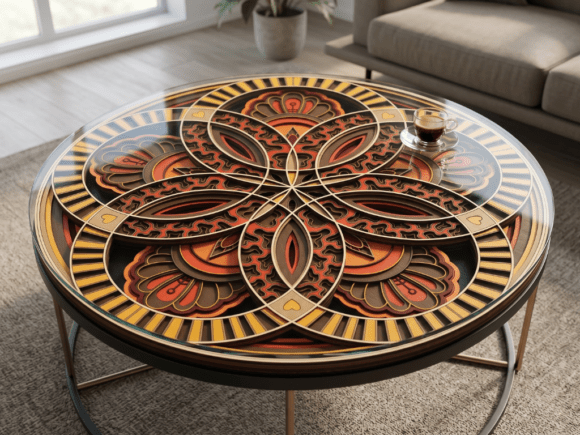
What distinguishes Coffee Table Design 4 from standard coffee table plans is its architectural complexity. The design is built upon a foundation of precision layering, utilizing a total of ten components. This includes one glass frame top structure support and nine individual wooden or composite layers, numbered sequentially from Layer 1 to Layer 9. Each layer is not simply a copy of the previous one; rather, they are strategically arranged to enhance depth, contrast, and dimensional clarity.
The result is a striking 3D visual effect that emerges only once the components are assembled. The radial-inspired geometric pattern creates a strong sense of movement, drawing the eye inward while maintaining a robust structural balance. This progressive layering technique allows clean geometric lines to evolve into a bold, sculptural form. In practical terms, this means the table does not just sit in a room; it becomes a focal point that defines the space through its intricate shadow play and textured surface.
For the fabricator, the layer structure is engineered for accuracy. Every component is optimized for precise laser cutting, ensuring that alignment pins or guides fit perfectly during assembly. This attention to detail minimizes the risk of gaps or misalignment, which are common pitfalls in DIY multilayer projects. The goal is a smooth assembly process that results in strong structural consistency, turning a stack of flat pieces into a durable piece of furniture.
Comparing Geometric Layering to Traditional Styles
When evaluating Coffee Table Design 4, it is helpful to compare it against traditional furniture styles and other modern alternatives. Conventional coffee tables often rely on solid wood construction, veneers, or simple joinery techniques like mortise and tenon. While these methods offer timeless durability, they typically lack the dynamic visual depth that a multilayer approach provides. A solid wood table presents a uniform surface, whereas Coffee Table Design 4 offers a gradient of texture and height that changes depending on the viewer's angle.
Compared to other geometric designs available in the market, this specific iteration leans heavily into the "radial" aesthetic. Many geometric tables utilize grid patterns, hexagonal tessellations, or random angular cuts. The radial inspiration here creates a more organic flow, mimicking natural forms like flower petals or ripples in water, yet retaining the rigidity required for a functional table. This makes it a unique middle ground between organic design language and industrial precision.
Furthermore, when compared to pre-assembled modern furniture, the primary difference lies in customization. Mass-market options come in fixed sizes and finishes. With Coffee Table Design 4, the user dictates the scale. If a standard 40-inch table feels too large for a studio apartment, the files can be scaled down without losing the integrity of the geometric pattern. Conversely, for a grand foyer, the design can be expanded significantly. This scalability is a significant advantage over rigid, off-the-shelf products, offering a tailored solution that fits specific spatial constraints.
Evaluating Strengths and Tradeoffs
Every design choice involves tradeoffs, and Coffee Table Design 4 is no exception. Its primary strength is undoubtedly its aesthetic versatility and the high-impact visual it delivers. The combination of nine layers creates a rich, textured surface that can elevate the perceived value of a room. It is particularly well-suited for modern interiors, premium custom builds, and spaces where the furniture needs to double as art.
However, there are limitations to consider. The assembly process requires patience and a level of technical skill that exceeds basic furniture building. Aligning nine separate layers demands a steady hand and potentially specialized jigs or fixtures to ensure the stack remains true. If the layers shift even slightly during gluing or clamping, the final symmetry can be compromised. Additionally, the cost of materials may be higher than a simple slab table due to the increased volume of wood or acrylic required to cut all nine layers.
Another factor is the finishing process. Because the design relies on the interplay of light and shadow between layers, the finish must be consistent across all components. Staining or painting unevenly can disrupt the visual rhythm of the radial pattern. This necessitates a thorough preparation phase, including sanding and sealing each layer individually before assembly, which adds time to the project timeline.
Despite these challenges, the tradeoff often favors the builder who values uniqueness over convenience. The resulting piece is not something that can be replicated easily by competitors or found in big-box stores. It represents a commitment to craftsmanship and a desire for a truly bespoke object.
Decision Factors: Is This Design Right for You?
Determining whether Coffee Table Design 4 is the right choice depends largely on your goals, resources, and environment. This design is an excellent fit for several specific scenarios:
- Custom Fabrication Projects: If you have access to a laser cutter or CNC machine and are looking for a project that showcases these capabilities, this design is ideal. It demonstrates precision and complexity effectively.
- Modern Interior Themes: Homes with contemporary, minimalist, or industrial decor benefit most from the clean lines and bold geometry of this table. It complements sleek sofas and metal accents without overwhelming the space.
- Scalable Needs: If you require a specific dimension that is hard to find in retail, the fully scalable nature of the files makes this a superior alternative to searching for custom-made inventory.
Conversely, there are situations where another option might be more appropriate. If you are a beginner with limited woodworking experience, the complexity of aligning nine layers might be discouraging. In such cases, a simpler two-layer design or a solid wood plan would be a better starting point. Similarly, if the project timeline is extremely tight, the labor-intensive nature of cutting, finishing, and assembling multiple layers could cause delays. Finally, for traditional or rustic interiors, the sharp, geometric aesthetic of Coffee Table Design 4 might feel out of place, suggesting that a more organic or classic style would be a better match.
Practical Implementation and Material Considerations
When moving from concept to creation, the choice of material plays a pivotal role in the final outcome. While the design files are versatile, the physical properties of the material will dictate the table's longevity and look. Plywood is a popular choice due to its stability and resistance to warping, but it requires careful edge banding to hide the ply layers. MDF offers a smoother surface for painting but is heavier and less resistant to moisture. Acrylic or glass can be used for certain layers to introduce transparency, further enhancing the 3D effect, though this introduces fragility concerns.
The inclusion of a glass frame top structure support is a critical component of the design. This element not only protects the layered base but also provides a stable surface for daily use. When selecting glass, consider the thickness and type (tempered vs. annealed) to ensure safety and durability. The interaction between the glass and the underlying geometric layers creates a seamless transition from art to function.
Ultimately, Coffee Table Design 4 represents a convergence of digital design and physical craftsmanship. It challenges the maker to think beyond flat surfaces and embrace the potential of depth and layering. By understanding its structure, comparing it to alternatives, and weighing the practical implications of its assembly, you can make a confident decision about whether this design aligns with your vision. Whether you are a professional fabricator or a dedicated hobbyist, the opportunity to create a high-impact, custom piece of furniture is a compelling reason to explore this geometric masterpiece.